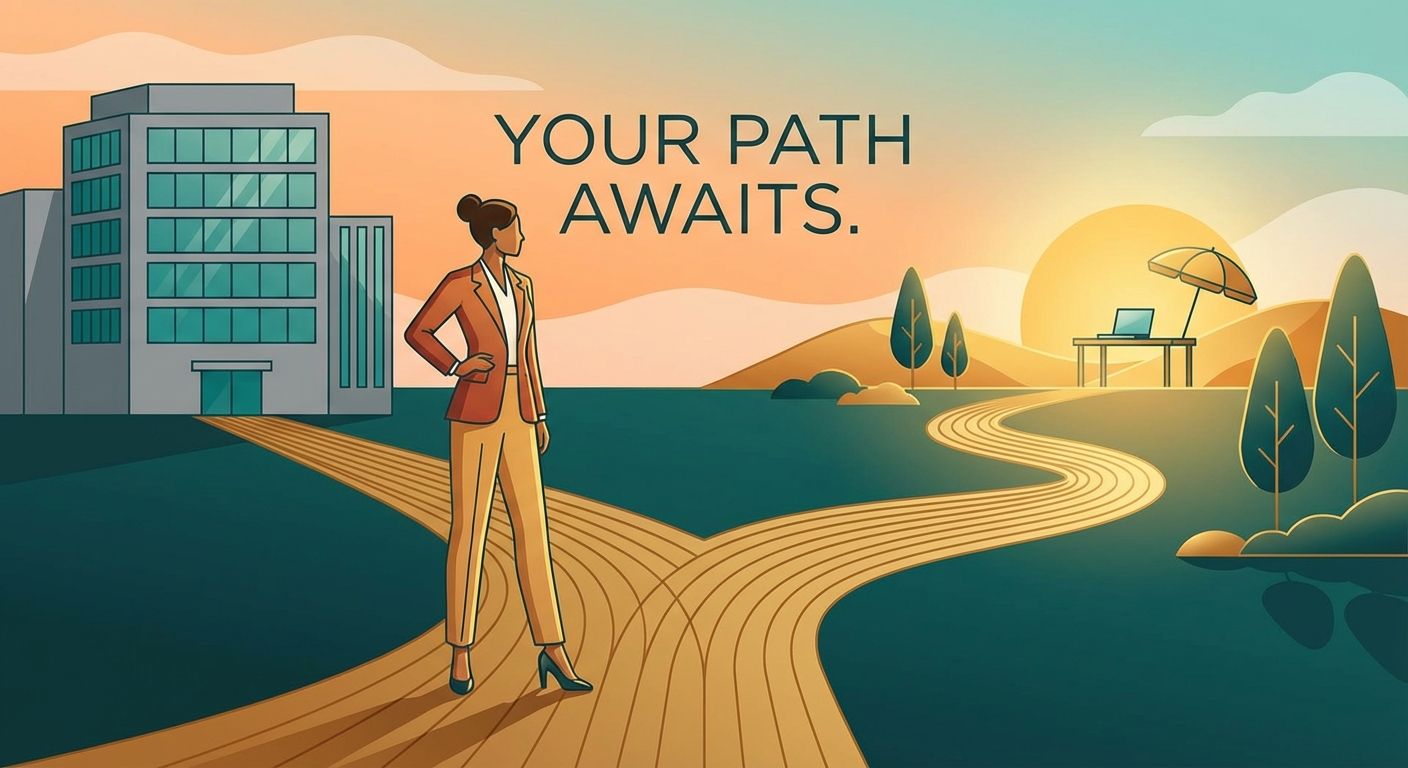
Something shifted in the past few years. You can feel it in conversations with friends who just quit their jobs. You can see it in the LinkedIn posts celebrating "new chapters." You can measure it in the statistics: self-employment is now the fastest-growing segment of the workforce in multiple countries.
But 2026 isn't just another year of gradual growth in freelancing. It's a tipping point. The year when working for yourself stops being the alternative path and starts being the obvious one.
Here's why this moment is different—and what it means for anyone considering the leap.
The Promise That Broke
For generations, the deal was simple: show up, work hard, be loyal, and the company will take care of you. Steady paycheck. Health insurance. Retirement plan. Career progression. Security.
That deal is dead.
Throughout 2025, we watched companies treat employees with stunning disregard. Rolling layoffs with thousands let go at a time. Return-to-office mandates designed to force voluntary resignations. Unchecked workloads dumped on "survivors" after each round of cuts. Promises of stability that lasted until the next earnings call.
And this wasn't happening at struggling companies. It was happening at profitable ones. Billion-dollar enterprises laying off workers while reporting record revenue. The message was clear: loyalty is a one-way street.
Workers noticed. And they're done pretending the old deal still exists.
The Great Realization
Here's what millions of people figured out: depending on a single employer for 100% of your income isn't security. It's concentrated risk.
Think about it through the lens of any other investment. Would you put your entire retirement savings into a single stock? Of course not. That's obviously risky. Diversification is fundamental.
Yet for decades, we've been taught that putting 100% of our earning capacity into a single employer is the "safe" choice. One company. One boss. One decision-maker who can eliminate your income with a single conversation.
Self-employment flips this equation. Five clients paying you $2,000/month is more stable than one employer paying $10,000/month. Lose one client, you lose 20% of your income. Lose your job, you lose everything.
This isn't just a mindset shift. It's a mathematical reality that a generation of workers now understands viscerally.
Why 2026 Is the Tipping Point
The self-employment revolution didn't start this year. But several forces are converging to make 2026 the moment it becomes mainstream:
1. The Infrastructure Finally Exists
Ten years ago, going solo meant figuring out invoicing, contracts, health insurance, retirement accounts, and a dozen other operational headaches from scratch. Today, there's a tool for everything. Stripe Atlas sets up your business entity. Gusto handles payroll and benefits. Mercury provides banking. Notion organizes your operations. The friction of self-employment has dropped dramatically.
2. AI Amplifies Individual Output
A solo consultant in 2026 can produce work that would have required a team in 2020. AI handles first drafts, research synthesis, data analysis, and routine communications. This doesn't replace expertise—it amplifies it. The solopreneur who deeply understands their craft can now deliver at a scale that wasn't previously possible without employees.
3. Remote Work Proved the Model
The pandemic forced a global experiment in distributed work. And it worked. Clients discovered that they didn't need someone in an office to get quality work done. They needed someone who could deliver results. This broke the assumption that "real work" requires physical presence—and opened the door for service providers to work with clients anywhere.
4. The Talent Market Has Shifted
Companies facing budget pressure are increasingly turning to fractional talent instead of full-time hires. Why pay a $150,000 salary plus benefits for a marketing director when you can engage a fractional CMO for specific initiatives? This creates opportunity for experienced professionals to serve multiple clients at rates that exceed what they'd earn as employees.
The Psychological Shift
Perhaps the biggest change is internal. Previous generations measured success by employment status: job title, company prestige, climbing the corporate ladder. Today's workers increasingly measure success by autonomy: control over time, choice in projects, freedom from office politics.
This isn't laziness or lack of ambition. It's a redefinition of what ambition means.
The solopreneur working from a home office, earning what they need, choosing their clients, and picking up their kids from school isn't "settling." They've achieved something most corner-office executives never will: actual control over their life.
Gen Z and younger millennials watched their parents sacrifice everything for employers who discarded them without hesitation. They learned the lesson: don't let someone else hold all the cards.
What Successful Solopreneurs Do Differently
Not everyone who leaves traditional employment thrives. The difference between solopreneurs who build sustainable businesses and those who burn out comes down to a few key practices:
They Treat It Like a Business, Not a Job
The biggest mistake new solopreneurs make is thinking of themselves as employees without an employer. They trade hours for dollars and wait for clients to tell them what to do.
Successful solopreneurs think like business owners. They build systems. They create processes. They invest in marketing. They price based on value, not time. They make decisions that compound over months and years, not just optimize for next week's income.
They Build Before They Need To
The worst time to find clients is when you desperately need them. Successful solopreneurs maintain relationships, create content, and stay visible even when they're fully booked. They build their pipeline during abundance so they're never negotiating from weakness.
They Automate the Friction
Administrative work is the silent killer of solo businesses. Invoicing, scheduling, follow-ups, proposals—these tasks don't generate revenue, but they consume hours. Successful solopreneurs systematize and automate everything that isn't core to their value delivery. They protect their time for the work only they can do.
They Charge What They're Worth
Underpricing is epidemic among new solopreneurs. They calculate their old hourly wage and add a small premium, not realizing they now have to cover benefits, taxes, unpaid time, and business expenses.
Successful solopreneurs price based on the value they create for clients, not the hours they spend. They understand that premium pricing attracts better clients and allows for better work. They'd rather have three great clients at high rates than ten difficult ones at low rates.
The Fear That Holds People Back
If self-employment is so advantageous, why doesn't everyone do it?
Fear. Specifically, fear of the unknown and fear of inconsistency.
Employment feels safe because the paycheck arrives reliably (until it doesn't). Self-employment feels risky because income varies month to month. But this is an illusion. The employee has binary risk: employed or not. The solopreneur has graduated risk: busier months and slower months, but rarely zero.
The other fear—not knowing how to run a business—is increasingly solvable. The infrastructure exists. The information is available. The communities of people who've done it are willing to help. The barrier isn't knowledge. It's the decision to start.
The Year to Make the Leap
None of this means traditional employment is dead. Some people genuinely prefer it, and that's valid. Some industries and career stages benefit from it.
But if you've been thinking about going solo—if you've been sketching business ideas, saving money, testing the waters with side projects—2026 might be your year.
The infrastructure is ready. The market is receptive. The tools are powerful. And the old promise of stable employment? It's not coming back.
The self-employment revolution isn't about rejecting work. It's about reclaiming it. Taking control of your time, your income, your clients, and your future.
The question isn't whether you can afford to go solo. Increasingly, it's whether you can afford not to.
 QuickBooks
  Xero
Xero  FreshBooks
  Wave
Wave