 QuickBooks
  Xero
Xero  FreshBooks
  Wave
Wave Final Notice Emails That Get Results Without Burning Bridges
If you've reached the point of writing a final notice email, you've probably already done everything by the book — the invoice went out on time, you sent a poli...
Read More
Your first invoice reminder went unanswered. Here's exactly what to write in your second reminder — when to send it, the tone to use, and four ready-to-use templates that get clients to pay without damaging the relationship.

You sent the first payment reminder almost a week ago. It was friendly, brief, the kind of message anyone would happily reply to. And then — nothing. No bounce, no out-of-office, just silence.
If you're staring at a quiet inbox trying to decide what the next email should say, you're in one of the most uncomfortable spots in service-business life. Send too soon and you feel pushy. Wait too long and the invoice keeps aging while your cash flow tightens. The wrong tone risks the relationship; the wrong silence risks the payment.
This guide walks through exactly what to say in your second reminder — when to send it, the tone shift it needs, the five-part structure that gets replies, and four ready-to-use templates. By the end you'll have a calm, professional message you can actually send today.
Before you write anything, assume the most charitable explanation. First reminders get ignored for boring, predictable reasons: the email landed during a busy stretch and got buried; the client read it on their phone, intended to come back to it, and forgot; the invoice sits in a different inbox or on a bookkeeper's desk; or your message looked enough like a system-generated email that it slid past their attention.
Notice what's missing from that list: "the client doesn't want to pay you." Most late payments are operational, not adversarial. As small-business reporting on unpaid invoices (Halston Media's practical guide) makes clear, the majority of overdue accounts get resolved with a polite, well-timed nudge rather than escalation. The work is in the timing and the wording, not the pressure.
Your second reminder works best when it carries that same assumption forward: this is probably an oversight, and you're helping them resolve it quickly. That single mental shift — from "why aren't they paying me" to "how do I make this easy to act on" — changes every word you choose.
The most common mistake is sending the second reminder too soon. If your first message went out a day or two after the due date, leave a 5–7 day gap before the second one. That window is long enough that the client has had time to act, short enough that the invoice hasn't slipped from "late" into "forgotten."
If you sent your first reminder as a pre-due-date heads-up, the second lands roughly 3–5 days after the actual due date. Either way, you're aiming for the moment a client would naturally expect a follow-up but hasn't had time to feel hounded.
Time your send for Tuesday, Wednesday, or Thursday morning if you can. Monday inboxes are chaotic, Friday afternoons get archived, and weekends push your message to the bottom of the pile by Monday.
Your first reminder probably read like a friendly check-in — warm, breezy, almost apologetic about bringing it up. The second reminder needs to keep that warmth while adding two new ingredients: clarity and direction.
Clarity means stating the facts without softening them into invisibility — the amount, the invoice number, the original due date, and the days overdue all belong in the message in a way the client can scan in three seconds. Direction means giving them a specific next step rather than waiting for them to figure it out, whether that's a payment link, a single-sentence question they can answer, or a date you'd like to confirm.
What you do not want to do is escalate emotionally — no exclamation points, no underlined words, no "I really need this resolved," and no implied disappointment. The message should read like it was written by a calm, organized assistant, because that's the version of you the client will respond to fastest.
Every effective second reminder has the same skeleton. The order is what makes the message feel professional rather than pleading:
The structure does the emotional work for you. If the facts are there, you don't need to underline urgency. If the next step is one click, you don't need to ask twice. If the opener assumes the best, the rest of the email reads as helpful rather than confrontational.
Pick the one that fits your situation, swap in the details, and send. Each is written to be copied into your invoicing tool or email client without further editing.
Subject: Quick check-in on Invoice #1042 ($1,800)
Hi [Client first name], hope your week is going well. Checking in on Invoice #1042 for $1,800, originally due [date] — it's about a week past due and I haven't seen it come through yet. Totally possible it slipped past. Original invoice and a payment link are here: [link]. If there's anything you need from me to get it processed, just let me know. Thanks so much, [Your name].
Subject: Invoice #1042 — quick forward to the right person?
Hi [Client first name], following up on Invoice #1042 for $1,800, due [date]. I know invoices on your end usually go through your bookkeeper or AP — would it be easier if I sent it directly to them, or would you prefer to forward it? Happy to do either. Invoice and payment link for reference: [link]. Thanks, [Your name].
Subject: Did Invoice #1042 reach you OK?
Hi [Client first name], circling back on Invoice #1042 for $1,800 (due [date]) — want to rule out the chance it ended up in spam. Could you confirm you received it? If anything looks off (wrong PO, wrong contact, wrong amount), let me know and I'll fix it and resend a clean copy. Invoice and payment link: [link]. Thanks, [Your name].
Subject: Invoice #1042 — payment by [next Friday]?
Hi [Client first name], following up on Invoice #1042 for $1,800. It's now [X] days past due ([original date]). Would you be able to get it processed by [a specific date 5–7 days out]? That gives me enough lead time to plan around it. If that date doesn't work, send me one that does and we're sorted. Payment link: [link]. Thanks, [Your name].
There are three moves that feel right in the moment but quietly damage either the relationship or your chance of getting paid quickly. Avoid all three.
Once you send the second reminder, one of four things tends to happen. Plan for each in advance so you're not improvising the day the reply lands.
If the client pays, send a short thank-you within 24 hours. It costs you nothing and reliably speeds up the next invoice you send them.
If the client replies with a small question ("can you re-send to my AP team," "I think the address is wrong"), treat it as a quick win. Resolve it the same day and confirm in writing what you did.
If the client asks for an extension or a payment plan, decide your default policy ahead of time. A common one: a single 14-day extension for clients in good standing, or a 50/50 split paid two weeks apart for larger invoices.
If the client doesn't reply at all, that's still information. It tells you the account needs a third reminder on a different channel — a quick phone call or text — to break the email pattern that clearly isn't working.
Once your second-reminder template and cadence feel right, the next move is letting a tool fire it for you on day six in the same warm voice you'd write yourself. A reminder service like DueDrop keeps the follow-ups off your to-do list while leaving your invoicing exactly where it is.
Yes. Reply in the original thread rather than starting a new email. It preserves context, keeps the invoice details visible, and signals you've been calmly tracking the conversation.
You can soften the opener but keep the structure identical. The biggest mistake friendly relationships create is dropping the facts (invoice number, amount, due date) because it feels too formal. Keep them in — clarity is kindness.
Yes, and it's one of the highest-leverage moves you can make. Re-attaching the original invoice removes any "I can't find it" friction. Paired with a one-click payment link, you've eliminated the two most common reasons second reminders go ignored.
Most service businesses get the best results with two emails, then a brief phone or text touchpoint, then a third email if the call doesn't connect. Past three written reminders without a reply, the channel is the problem — not the wording.
Only if your contract or invoice clearly stated one. Even then, mention it factually ("per our agreement, a 1.5% late fee applies after 15 days past due") rather than as a threat. The second reminder is rarely the right place to introduce a fee that wasn't already in the deal.
Five principles to keep close — they'll make every second reminder you send shorter, calmer, and more likely to get a reply:
For more on the timing layer, see our guide on the perfect invoice follow-up schedule, and for the message that should land before this one, read how to write a first payment reminder email without damaging the relationship.

If you've reached the point of writing a final notice email, you've probably already done everything by the book — the invoice went out on time, you sent a poli...
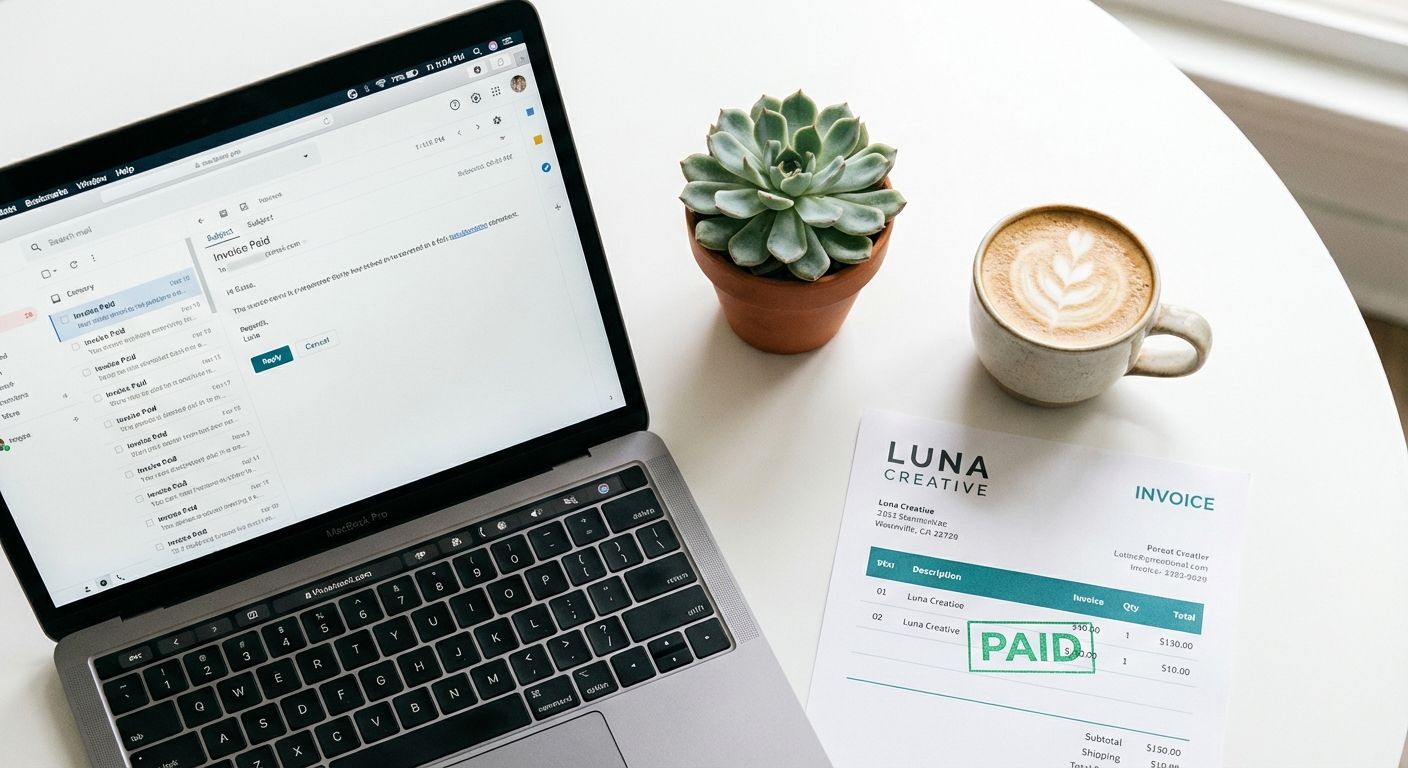
You've done the work. You've sent the invoice. Now you're staring at your inbox, wondering how to ask for your money without sounding desperate, aggressive, or...

You've done the work. The invoice went out weeks ago. The due date has quietly slipped past, and now you're staring at a blank email draft, trying to write the...
Connect your tools in five minutes. Let the first reminder go out tomorrow morning — sounding exactly like you'd write it yourself.
Start my free 14-day trial