 QuickBooks
 Xero
 FreshBooks
 Wave
When a Client Asks for Net 60: How to Respond Without Losing the Work
Quick answer: Treat net 60 as a default that can be discussed, not a take-it-or-leave-it demand. Weigh what it costs you, since billing at project end can mean...
Read More
Late payments cost service businesses $39,406 per year on average. See the full breakdown of how overdue invoices impact your cash flow, time, and business survival.
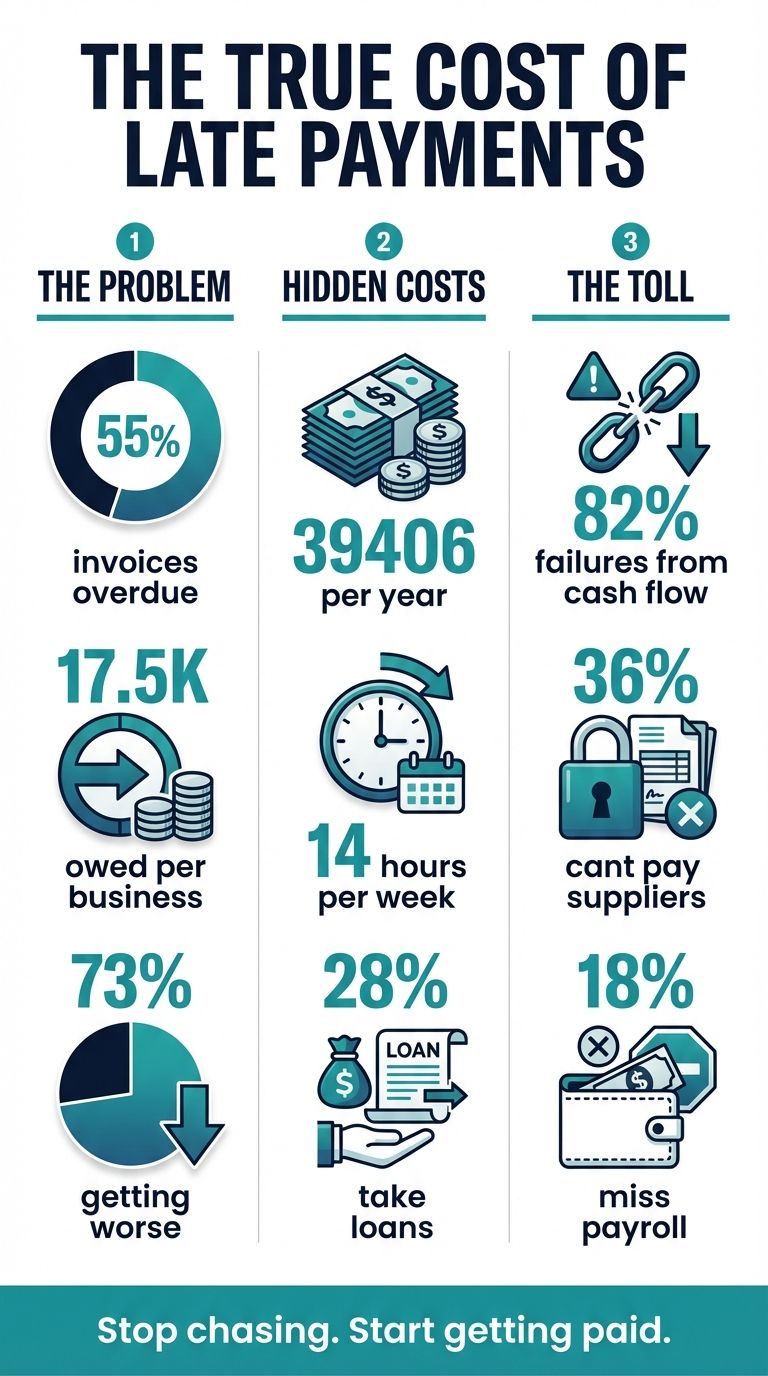
Quick answer: Late payments are costly for service businesses. Drawing on QuickBooks, Clockify and other sources, the article puts the average loss at $39,406 a year, including about 14 hours a week spent chasing invoices, plus financing costs and lost opportunities. A consistent, friendly follow-up process is the part you can control.
If you run a service business, you already know the frustration of waiting on payments. But do you know the real cost?
We analyzed the latest research from QuickBooks, Clockify, and other industry sources to quantify what late payments actually cost service businesses—from contractors and consultants to agencies and healthcare providers.
Here's what we found.
Late payments aren't a "you" problem—they're an industry-wide crisis. Over half of all B2B invoices in the U.S. are currently overdue, and 73% of businesses say the problem got worse over the past year.
Whether you're a plumber waiting on a homeowner, an agency waiting on a client, or a consultant waiting on a corporate accounts payable department—you're not alone.
The average service business loses $39,406 per year to late payments. That includes admin time spent chasing invoices (14 hours per week), financing costs from loans taken to cover gaps (28% of businesses do this), and lost opportunities.
Think about that: you're paying interest on borrowed money because someone else didn't pay you on time.
Cash flow problems caused by late payments create a domino effect. 36% of businesses can't pay their own suppliers on time. 18% have struggled to make payroll. And 82% of small business failures trace back to cash flow issues.
Your client's delay becomes your supplier's delay, and suddenly the whole chain is under stress.
You can't control when clients pay. But you can control your follow-up process.
The businesses that get paid faster aren't necessarily the ones with stricter terms—they're the ones with consistent, friendly follow-up systems. A well-timed reminder can make the difference between payment this week and payment next month.
That's exactly why we built DueDrop. Instead of spending 14 hours a week chasing payments, let AI handle the follow-up with messages that sound like you wrote them—professional, friendly, and effective.
QuickBooks 2025 Small Business Late Payments Report: quickbooks.intuit.com/r/small-business-data/small-business-late-payments-report-2025
Clockify Late Invoice Statistics 2025: clockify.me/late-invoice-statistics
Chaser HQ Late Payments Report: chaserhq.com/the-2022-late-payments-report
GoCardless/FSB Late Payments Report 2025: gocardless.com/blog/gocardless-fsb-late-payments-report-2025

Quick answer: Treat net 60 as a default that can be discussed, not a take-it-or-leave-it demand. Weigh what it costs you, since billing at project end can mean...

Quick answer: An early payment discount is really a financing fee, and it is more expensive than it looks. A 2/10 net 30 offer sounds tiny but can be costly whe...

Quick answer: When a client uses an accounts payable portal, your invoice sits in a queue and only moves forward if it matches what the system expects, such as...
Connect your accounting system and your inbox. DueDrop will draft the first follow-up from the conversation you already have with that client — and nothing sends until you approve it.
Draft my first follow-up